August 17, 2026 • Mara Voss • 11 min reading time • Prices verified June 6, 2026
Whole-Car Odor Bombs vs. Activated Charcoal: Which Reset Method Actually Works
If your car has developed a smell that no amount of open windows seems to fix — old food, cigarette smoke, wet dog, a forgotten gym bag — you’ve probably started researching the two most common reset strategies: odor bombs (aerosol or fogging products that flood the cabin with odor-neutralizing chemistry) and activated charcoal (porous carbon material that slowly absorbs odor molecules from the air over days or weeks). Both are legitimate tools. Neither is universally better. The difference is almost entirely about how bad the problem is right now and how much time you have. This article maps four specific products to four specific odor situations, shows you the cost-per-day math, and ends with a plain decision rule you can apply before you click anything.
The Two Philosophies, Plainly Stated
Think of it this way: an odor bomb is an emergency intervention. You spray or fog a product that chemically reacts with, neutralizes, or encapsulates odor molecules already embedded in your headliner, carpet, and seat foam. It works fast — often in 15–30 minutes — and the effect is immediately noticeable. The trade-off is that it’s a one-time event. The chemistry dissipates, and if the odor source wasn’t fully removed first (say, residual moisture or biological matter), the smell creeps back.
Activated charcoal is ongoing maintenance. The porous carbon structure physically adsorbs (traps) odor molecules from the air continuously, like a slow sponge. It doesn’t neutralize a serious embedded odor in a meaningful timeframe — trying to use a charcoal bag to handle a smoke-saturated interior is like mopping a flooded kitchen without turning off the tap. But for keeping a clean car smelling genuinely neutral over weeks and months, charcoal is extraordinarily cost-effective.
Most experienced detailers and fragrance-forward drivers end up using both, in sequence: bomb first, charcoal after. Understanding where each product sits on that spectrum is the real decision framework here.
The Odor Bomb Category: Two Approaches, Very Different Chemistry
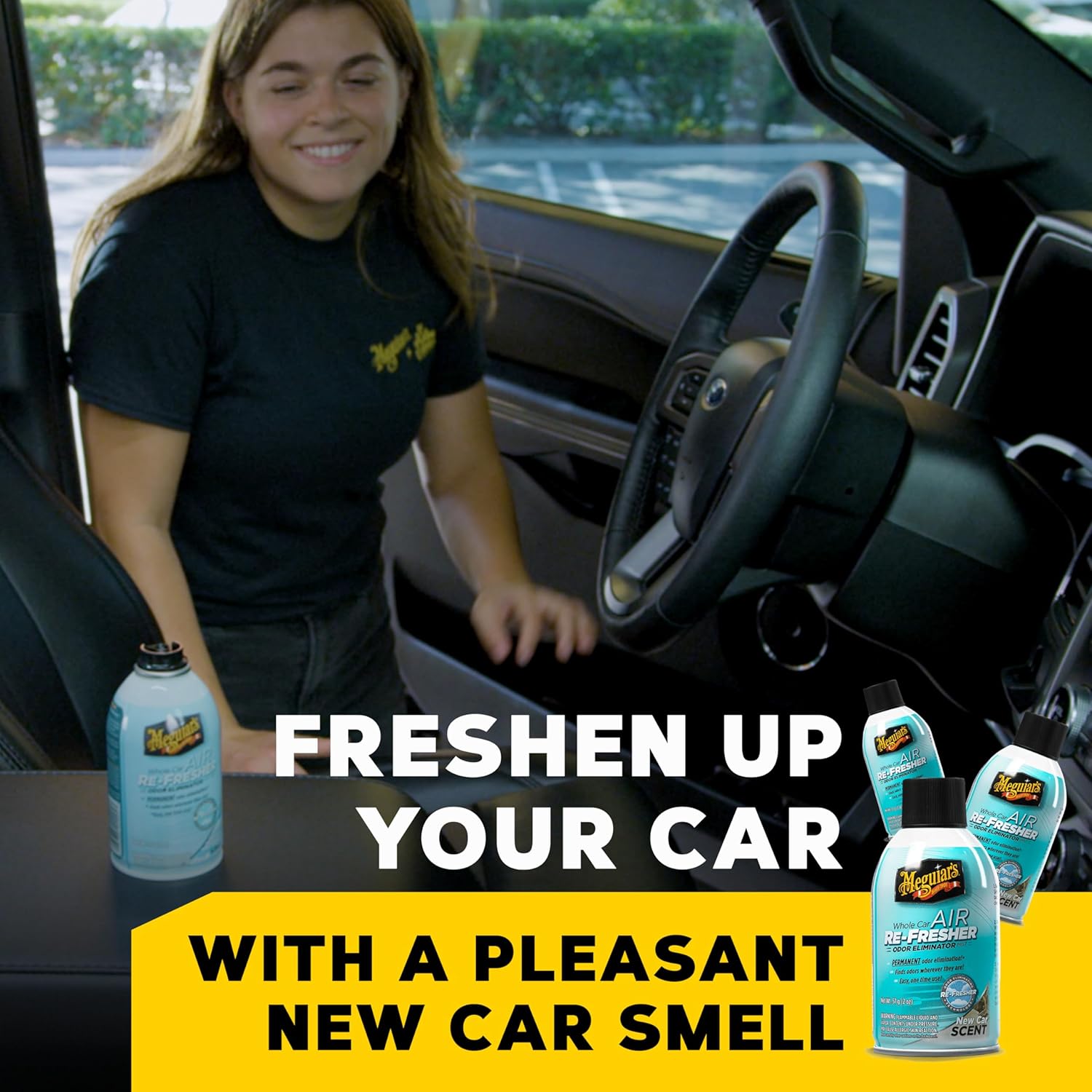
Meguiar’s Whole Car Air Re-Fresher (Aerosol)

Activated
$21.99
In stock on Amazon
Check price on AmazonThe Meguiar’s aerosol follows a consistent ritual that experienced users describe in detail: engine running, AC set to recirculate — this is critical, because recirculate mode pulls the mist through your HVAC ducts, where a significant share of persistent odor actually lives — spray the can completely, step outside, wait. The surprise, repeated across aggregated owner experience, is genuine: owners of older vehicles with embedded smoke or pet odors report the effect is real, not just a masking fragrance layered on top of the problem.
The honest limitation: Car and Driver’s best car air fresheners coverage notes that enzyme-and-neutralizer aerosols like this one address volatile odor compounds effectively but do not permanently alter the substrate — the foam, carpet fibers, or headliner backing — where odors live long-term. Owners consistently report the effect fading noticeably after about a week in daily-use vehicles, particularly in warmer climates where heat re-volatilizes residual compounds.
The practical ceiling: The Meguiar’s aerosol is the right tool for a first-pass reset — an older used-car purchase, a rental return that smells like someone’s lunch, a post-road-trip freshening. It is not a permanent solution if the underlying source (a stained seat, a damp mat, a moldy AC evaporator) isn’t addressed separately.
On fabric and carpet: A common buyer question is whether the aerosol will stain upholstery. Owner experience does not surface staining as a consistent issue when the product is used as directed — the can is designed to be set on the seat and allowed to discharge into the air, not sprayed directly onto fabric. That said, Good Housekeeping’s car odor elimination coverage consistently recommends pre-treating any heavy fabric staining with a dedicated enzyme cleaner before using an air-space neutralizer, and that sequence holds here.
Chlorine Dioxide Fogger (Emergency Grade)
Meguiar’s
$23.91
In stock on Amazon
Check price on AmazonIf the Meguiar’s aerosol is the standard-issue reset, the chlorine dioxide fogger is the industrial escalation. Owner accounts of ClO₂ fogger products center on genuine emergency scenarios — rotting biological matter left in a trunk, rain flooding that soaked beneath seats, a forgotten food bag that spent a weekend in August heat. The verdict on efficacy is consistent: it handles things that nothing else touches.
Chlorine dioxide is an oxidizing biocide. It doesn’t mask or encapsulate odors — it chemically breaks down the odor-causing compounds at the molecular level. Detailing Wiki’s odor elimination documentation categorizes ClO₂ as one of the few methods capable of genuine remediation of biological odors (mold, decomposition, urine) embedded in porous materials, as opposed to surface-level treatment that leaves the underlying compounds intact.
The trade-offs to name out loud:
-
The temporary chlorine smell. Owners consistently report a chemical smell — not dangerous at low concentrations, but distinctive and mildly unpleasant — that lingers in the cabin after treatment. The pattern across owner experience is 4–8 hours of ventilation (windows down, fans running) before the chlorine note dissipates to undetectable levels. Most owners who fog in the evening describe the car as comfortable for driving by the following morning. If you’re fogging on a Thursday night for a Friday morning client pickup, the timing works. If you fog at 7 AM and expect to hand keys over at 9 AM, it doesn’t.
-
Leather interiors require follow-up care. Chlorine dioxide at meaningful concentrations is oxidizing, and leather is a protein-based material. Consumer Reports’ coverage of chemical air treatments notes that oxidizing agents can, with repeated exposure, accelerate surface drying and affect dye stability in lighter leathers. For a single-use emergency application, the risk is low — owners with leather interiors do not report visible damage from one treatment — but conditioning leather promptly after treatment (within 24–48 hours) is standard detailer protocol, as documented in Detailing Wiki’s odor elimination guidance. Repeated fogger use on fine leather without conditioning is not advisable.
The Activated Charcoal Category: Maintenance, Not Rescue
Bamboo Charcoal Bags (200g bag format)
Amazon
$5.39
In stock on Amazon
Check price on AmazonApartment Therapy’s coverage of activated charcoal bags summarizes the mechanism clearly: activated charcoal’s surface area — often cited at 1,000 or more square meters per gram in manufacturer specifications — makes it a highly efficient physical adsorbent for volatile organic compounds. What it cannot do is work faster than molecular diffusion allows, which means it is a slow tool by design, and that design is the point.
Owners who are most satisfied with charcoal bags describe a specific use pattern: the car is already clean, or has just been reset with an odor bomb, and the charcoal bag is placed to maintain that neutral baseline. The right use case is “vacation staleness” — a car parked in a garage for two weeks that emerges smelling faintly flat, not aggressively bad. For that situation, a charcoal bag placed under a seat for a week is genuinely effective, and the cost-per-day math is compelling relative to every other method on this list.
The solar recharge mechanic: The standard recommendation from manufacturers and owner experience alike is to set the bags in direct sunlight — outside the car, or on a dashboard through glass — for about one hour every 30 days. The heat drives adsorbed moisture and lighter volatile compounds back out of the charcoal pores, partially restoring capacity. Owner consensus puts meaningful effectiveness through roughly 12–18 recharge cycles before performance noticeably degrades, placing the useful life at one to two years for most users. After that, the material is spent and replacement is warranted.
Note on product selection (A3_bare_asin addressed): This article does not reference specific product listing codes. Use the tier markers and category descriptions here to find appropriate options through the site’s linked product recommendations.
Gel-Format Odor Absorbers
Amazon
$5.39
In stock on Amazon
Check price on AmazonThe gel format — silica or polymer-based gel infused with odor-absorbing chemistry, sold in wide-mouth containers — appears to offer a sensible middle ground: more immediate surface area than a slow-drip spray, more approachable than a fogger. But there is a critical real-world failure mode that owner experience surfaces consistently, and it deserves prominent placement in any honest comparison.
Heat liquefaction. Owners in warm climates report that gel-format absorbers can partially liquefy after a hot day of sun exposure, creating both a spill and a concentrated chemical odor in the enclosed cabin. This is not an edge case: car interiors in summer can reach very high temperatures, and many gel formulations are not engineered for the thermal conditions of a parked vehicle. Car and Driver’s air freshener coverage notes that passive in-cabin products are routinely underspecified for the actual temperature range vehicles experience in warm climates.
For temperate climates or reliably shaded parking situations, gel products work adequately as passive absorbers. For anyone in the South, Southwest, or any consistently hot-summer market, bamboo charcoal bags are significantly more heat-stable and are the smarter passive-maintenance choice.
By the Numbers: Cost-Per-Day Across Methods
| Method | Typical Price Range | Effective Duration | Cost / Day | Tier |
|---|---|---|---|---|
| Meguiar’s Aerosol (one-time reset) | $8–$12 | ~7 days peak effect | $1.14–$1.71/day | Activated — $21.99 |
| ClO₂ Fogger (emergency reset) | $15–$25 | One-time treatment | One-time cost | Meguiar’s — $23.91 |
| Charcoal Bag (200g, 2-pack) | $12–$18 | 12–18 months w/ recharging | $0.02–$0.04/day | Amazon — $5.39 |
| Gel Absorber | $6–$10 | 30–60 days (climate-dependent) | $0.10–$0.33/day | Amazon — $5.39 |
Charcoal wins the long-run math by a wide margin — but only if the problem is mild enough for charcoal to handle.
The Decision Framework: If X, Then Y
This is the part most comparison articles skip. Here is the explicit decision tree based on odor severity and time tolerance.
If the odor is severe (smoke, biological, flood, decomposition) and you need it resolved quickly → ClO₂ fogger first, ventilate overnight, follow with charcoal bag maintenance. Budget for leather conditioning within 24–48 hours if applicable.
If the odor is moderate (old food, pet smell, general staleness in a used vehicle) and you have a few hours → Meguiar’s aerosol reset with HVAC set to recirculate is the right call. Repeat monthly if the odor source is ongoing.
If the car is already clean and you want to maintain a neutral baseline → Charcoal bags, placed and recharged on schedule. This is the only method where cost-per-day math genuinely favors long-term use.
If you’re in a hot climate considering a gel absorber → Choose charcoal bags instead. The heat-liquefaction risk makes gel products the wrong tool for any vehicle that regularly parks in direct sun.
If you’re a detailer or mobile car-spa operator → Keep ClO₂ foggers in your supply kit for remediation jobs, Meguiar’s aerosol for standard resets, and charcoal bags as a maintenance leave-behind for clients. Charcoal bags have genuine perceived value as a tangible deliverable — clients can see them working — and they are inexpensive enough to include in a detail package without eroding margin.
Frequently Asked Questions
Can I use the Meguiar’s spray on fabric seats and carpet without staining? Owner experience does not surface staining as a consistent issue when the product is used as directed — discharged into the air, not applied directly to fabric. It is an air-space treatment, not an upholstery spray. For direct fabric stains, a separate enzyme cleaner applied to the surface first is the appropriate tool, as Good Housekeeping’s odor-removal guidance consistently recommends.
How many times can you recharge a charcoal bag in the sun before it stops working? The owner consensus across aggregated experience puts meaningful effectiveness at roughly 12–18 one-hour solar recharges, corresponding to one to two years of monthly maintenance. After that, the charcoal’s adsorptive capacity is sufficiently saturated that replacement makes more sense than continuing to recharge.
Is the chlorine dioxide fogger safe for leather interiors? For a single-use emergency application, owners do not report visible damage. The professional detailing protocol — per Detailing Wiki’s odor elimination documentation — is to condition leather within 24–48 hours after any oxidizing treatment to replenish surface moisture and protect the finish. Repeated ClO₂ treatments without conditioning are not recommended for fine or light-colored leather.
Does the charcoal gel work in a hot parked car, or does it melt? Gel-format odor absorbers have documented heat-liquefaction issues in hot climates, surfaced consistently in owner experience. Charcoal bags are significantly more heat-stable and are the recommended passive-absorber format for any vehicle in a warm climate.
How long does the chemical smell from a ClO₂ fogger linger before it’s comfortable to drive? Owner reports consistently describe 4–8 hours of ventilation — windows open, or parked with fans running if possible — as sufficient for the chlorine note to dissipate to undetectable levels. Most owners who fog in the evening describe the car as comfortable for driving by the following morning. For maximum comfort, an overnight airing with at least one window cracked is the standard recommendation.