August 25, 2026 • Mara Voss • 11 min reading time • Prices verified June 6, 2026
Whole-Car Odor Bombs: Chlorine Dioxide vs. Enzyme Foggers for Catastrophic Car Smells
There are two kinds of bad car smells. The first kind is ambient — stale gym bag, week-old fast food wrappers, that faint odor you’ve stopped noticing but guests definitely haven’t. An air freshener handles that just fine. The second kind is the smell that makes you consider selling the car. Raw fish forgotten in Arizona summer heat. A flooded interior that sat wet for three days. Vomit that soaked through a seat cushion into the foam underneath. For that second category, you’re not shopping for a freshener — you’re shopping for an odor elimination system, a product designed to physically destroy the molecules causing the smell rather than cover them with fragrance. This article compares two of the most powerful tools available for exactly those situations: chlorine dioxide foggers (the “bomb” you activate and leave in a sealed car) and enzyme-based foggers or sprays (which use biological action to digest odor-causing organic material). If you’ve got a deal-breaking smell and you need to know which tool to reach for — and whether one treatment will actually fix it — this is the breakdown.
| EDITOR'S PICKMeguiar’s Whole Car Air Refresh… | Budget pickChlorine Dioxide Fogger Deodori… | |
|---|---|---|
| Size | 2 oz | — |
| Format | Mist | Fogger |
| Scent | New Car | — |
| Target odors | — | ✓ |
| Kit included | — | ✓ |
| Price | $23.91 | $19.95 |
| See on Amazon → | See on Amazon → |
What Each Technology Actually Does (and Where It Stops)
Understanding the mechanism isn’t nerdy — it’s how you set realistic expectations before you spend money and time on a treatment.
Chlorine Dioxide Foggers: Gas-Phase Oxidation
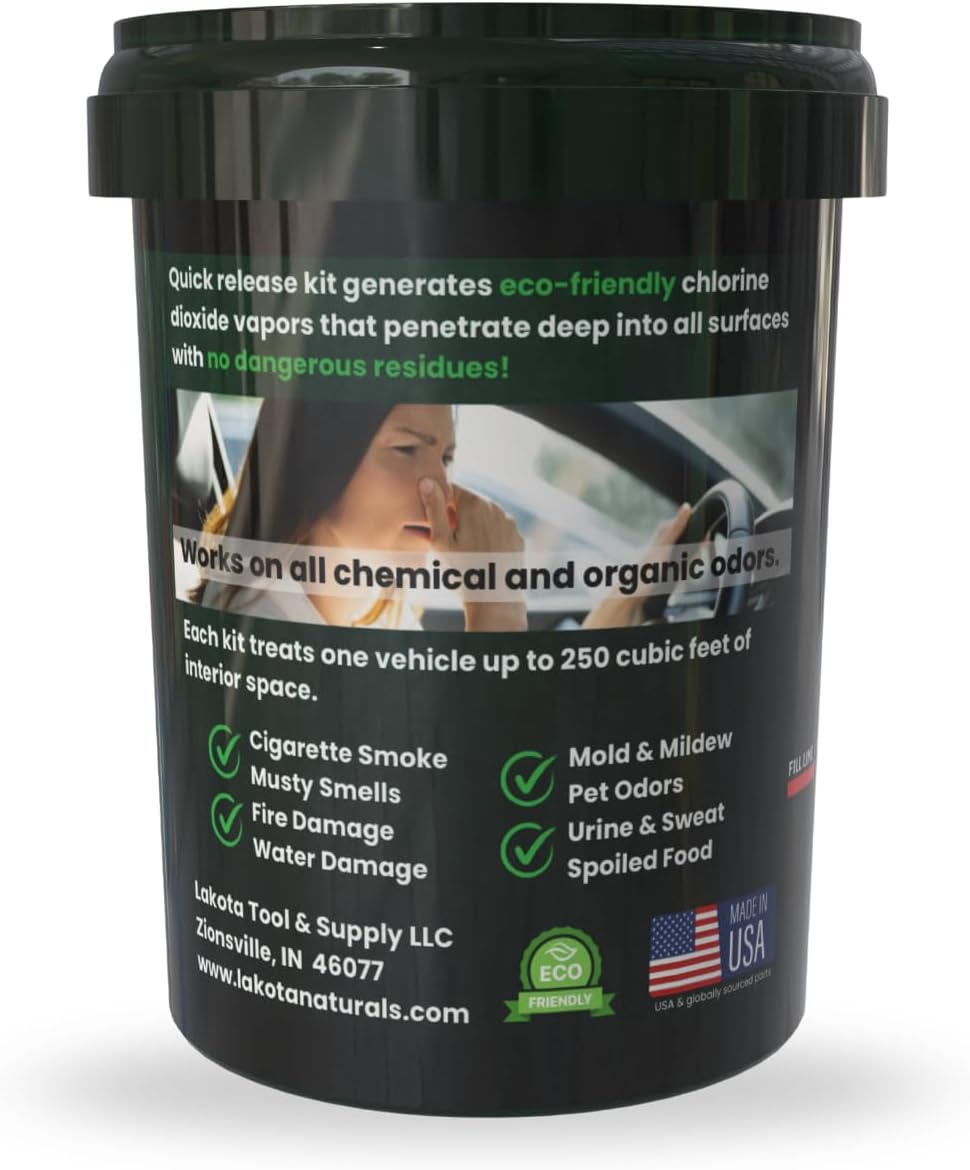
Chlorine dioxide (ClO₂) is a gas. When a ClO₂ fogger or tablet activates in a sealed cabin, it releases oxidizing gas that circulates through the entire interior — not just surfaces, but into HVAC ducts, under seats, into foam and carpet fibers the vacuum never reached. According to the Environmental Protection Agency’s Drinking Water Treatability Database entry on chlorine dioxide as a disinfectant, ClO₂ works by oxidizing organic compounds at a molecular level — chemically unmaking the odor molecules rather than covering them. This is why owners dealing with genuinely extreme contamination report results that airing out and enzymatic sprays alone couldn’t achieve. The gas gets everywhere the smell got.
The trade-off is real and consistent across owner reports: ClO₂ leaves its own residual smell. Multiple reviewers describe it as a “pool smell” or “bleach-adjacent” odor that lingers in the cabin for 12 to 36 hours after treatment before fully clearing. That’s not the product failing — it’s the mechanism clearing. But it means ClO₂ is not a same-day solution if you need the car for a client pickup or a dinner date tonight.
Meguiar’s
$23.91
In stock on Amazon
Check price on AmazonEnzyme Foggers and Sprays: Biological Breakdown
Enzyme foggers and sprays work differently. Enzymes are biological catalysts — proteins that break down specific types of organic matter. An enzyme formulated for uric acid destroys uric acid. One formulated for protein-based odors (meat, fish, vomit) targets those molecular chains. As Apartment Therapy’s overview of enzyme cleaners explains, the key limitation is specificity: enzymes need direct or close contact with the odor source, they need time to work (typically hours, not minutes), and they need moisture to activate. They don’t circulate as a gas, so a fogger disperses the enzyme solution as a fine mist to maximize coverage — but it’s still a liquid, not a penetrating gas. Deeply saturated foam or carpet padding may require multiple applications.
Enzyme fogger canisters are priced in the $12–$25 range for single-use treatments. Enzyme sprays in concentrate form offer better cost-per-use for multi-treatment situations where you’re systematically working through a problem over several days.
Meguiar’s
$23.91
In stock on Amazon
Check price on AmazonFragrance-Neutralizer Sprays: The Right Tool for the Right Job
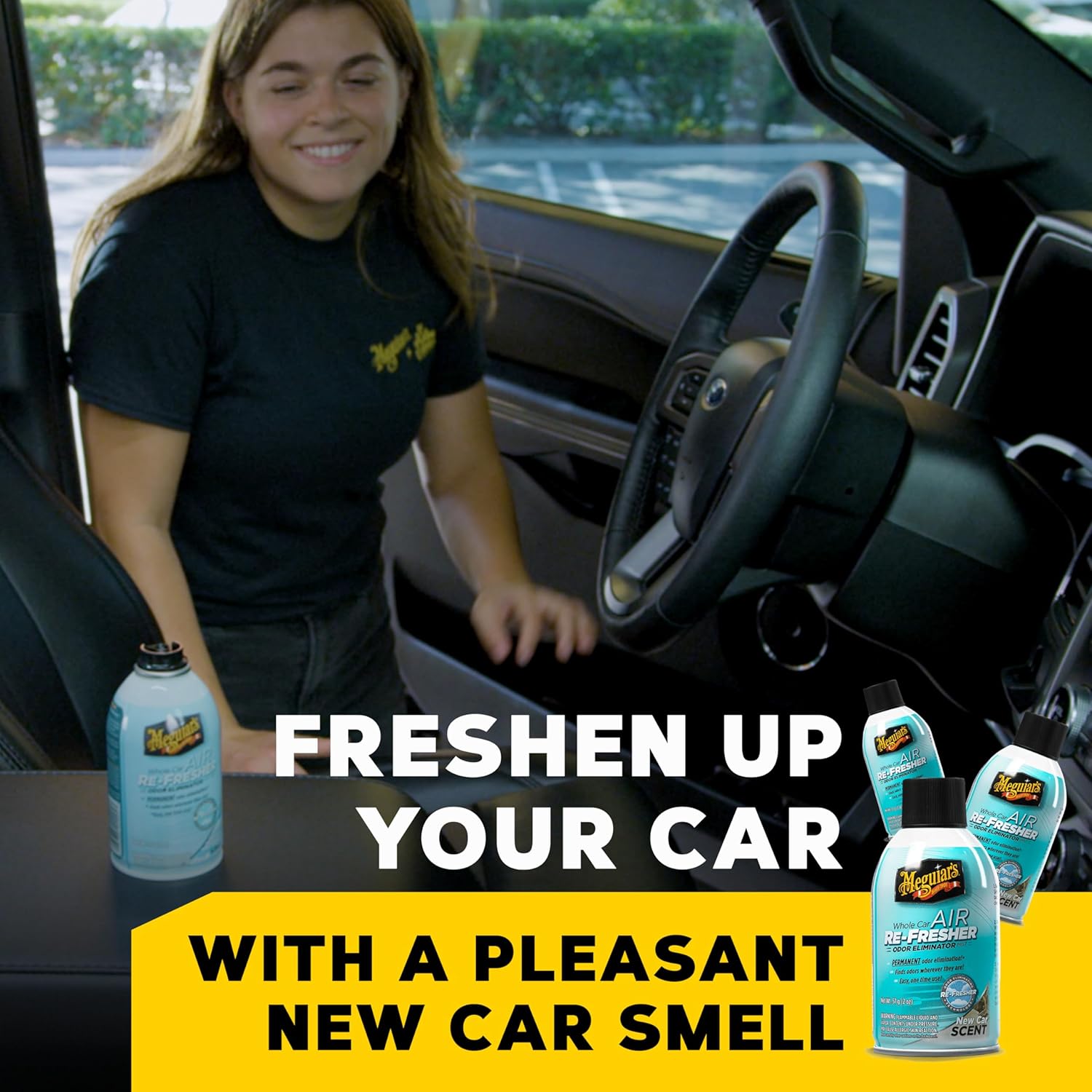
Meguiar’s Whole Car Air Refresher occupies a third category worth separating out honestly: it is primarily a fragrance-based cabin reset, not a molecular odor eliminator. The active chemistry is designed to neutralize odor molecules it contacts, but the dominant consumer experience is fragrance-driven. Car and Driver’s guide to the best car air fresheners draws this distinction clearly between odor neutralizers and odor eliminators when evaluating spray-and-fog products — a distinction that matters enormously when diagnosing which problem you actually have.
Reviewers consistently describe Meguiar’s as excellent for ambient commuter smells — gym bag odor, lingering food smells, stale air — and effective as a cabin reset that uplifts the whole interior for roughly a week. But in review aggregates, owners dealing with serious contamination (flooding, biological spills, pet accidents that soaked through to foam) note that the effect is primarily olfactory masking: the source smell returns once the fragrance fades. Priced in the $8–$12 range per can, it’s the right tool for the right problem — and the wrong tool for a serious one.
Chlorine
$19.95
In stock on Amazon
Check price on AmazonThe Decision Framework
Before you order anything, run this self-diagnostic to identify which tier of tool matches your actual situation.
| Situation | Right Tool |
|---|---|
| Ambient commuter odors, faint food smells, stale air | Meguiar’s Whole Car Air Refresher or comparable spray |
| Moderate biological contamination (pet accident, mild mildew) | Enzyme fogger or enzyme spray, possibly two treatments |
| Severe contamination (flooding, decomposing food, vomit in foam) | Chlorine dioxide fogger first, enzyme follow-up optional |
| Mold/mildew from flooding | ClO₂ fogger + source remediation (remove wet material first) |
| Smoke or chemical odors | ClO₂ fogger (enzymes require organic substrate; smoke is not one) |
Severity Diagnosis: Which Problem Do You Actually Have?
This is where practitioners make or lose the call.
Does the smell have an obvious source you can see or locate? If yes, remove it physically before any chemical treatment. No fogger eliminates an active biological source — a wet mat, a piece of decomposing food under a seat, standing water in a spare tire well. Detailing Wiki’s odor elimination techniques entry is explicit on this point: chemical treatments fail when the source is still present. ClO₂ will suppress the odor temporarily, but it will return.
Does the smell survive airing out with windows down for 24 hours? If a smell clears significantly with ventilation and sunlight, you’re likely dealing with volatile surface odors — enzyme spray or Meguiar’s is sufficient. If 24 hours of airing out makes no meaningful difference, the contamination has penetrated porous materials (foam, carpet backing, headliner), and you need gas-phase penetration. That’s the ClO₂ argument.
Is the smell biological in origin? Mildew, urine, vomit, fish, meat — all biological. Enzyme foggers are purpose-built for these. ClO₂ also handles them through oxidation. The distinction: enzyme action is slower and requires contact; ClO₂ gas is faster and penetrates further. For mold or mildew specifically, a common post-flooding complaint, Good Housekeeping’s guide to removing car smells recommends addressing moisture first and then applying an oxidizing treatment — consistent with the ClO₂ approach. Removing wet or saturated material before treatment is not optional; it’s a prerequisite.
Is the smell chemical or smoke-based rather than biological? Cigarette smoke, fuel odor, and chemical spills don’t respond as well to enzyme treatments — enzymes need an organic substrate to work. ClO₂ has broader oxidizing activity, and owner reports consistently show better results on smoke odors than enzyme-only approaches. If the smell is smoke, start with ClO₂ and don’t waste a treatment cycle on enzymes first.
The Cost-Per-Treatment Math
By the numbers:
- ClO₂ fogger kits: typically single-use, priced in the $15–$30 range per treatment; some brands offer multi-pack value tiers for multiple vehicles or repeat applications
- Enzyme fogger canisters: similar single-use pricing at $12–$25; enzyme sprays in concentrate form offer better cost-per-use for multi-treatment situations
- Meguiar’s Whole Car Air Refresher: mass-market price point at roughly $8–$12 per can; effect lasts approximately one week before re-application
For professional detailers treating a client vehicle with a serious odor problem, the math shifts: ClO₂ is typically a one-treatment resolution on severe cases (with the 24-hour wait period priced into the job timeline), while enzyme treatments may require two rounds, adding labor time. Detailing Wiki’s odor elimination techniques entry notes that professional detailers often deploy ClO₂ as the escalation option precisely because it reduces callback risk — one billable treatment with a high success rate beats two moderate treatments with an uncertain outcome.
Can You Layer These Treatments?
Yes, and in severe cases you probably should — but sequence matters.
The established professional protocol described in Detailing Wiki’s odor elimination framework:
- Physical source removal and cleaning first — no chemical treatment works on an active source
- ClO₂ fogger treatment — sealed car, 3–6 hours, then ventilate for 12–24 hours
- Enzyme spray or fogger follow-up — targeting any remaining biological material the ClO₂ oxidized but did not fully break down
- Fragrance-based cabin reset — Meguiar’s or a comparable spray as the final step; at this point it’s doing its intended job of delivering a pleasant cabin environment, not masking an unresolved problem
Running Meguiar’s on top of a ClO₂ treatment is fine and actually a natural ending to the sequence. What doesn’t work: using Meguiar’s first to “test” whether the smell has cleared. Fragrance masking obscures your ability to assess whether the underlying contamination was actually resolved. Sequence these tools in the right order and each one performs its designed function. Sequence them backward and you’re just delaying the diagnosis.
Frequently Asked Questions
Is a chlorine dioxide fogger safe to use in a leased car? At manufacturer-specified concentrations for automotive use, ClO₂ is formulated to be safe on interior surfaces — fabric, vinyl, leather, and plastic. Owner reports do not surface material damage at proper use concentrations. That said, document the pre-treatment condition and follow label instructions exactly. The bigger lease-related risk is running a ClO₂ treatment instead of disclosing a serious odor problem at turn-in — a severe odor can trigger a cleaning fee that costs more than the treatment.
How long does the chlorine smell last after treatment? Across owner reports, the residual pool/chlorine odor clears within 12 to 36 hours with windows open and ventilation. Leaving the car in sunlight with windows cracked accelerates clearing. Plan for it — don’t run this treatment the night before you need the car for something important.
Can I use Meguiar’s on top of a fogger treatment? Yes — this is the recommended finish step after the ClO₂ has cleared. Once the oxidizing smell has dissipated and you’ve confirmed the source odor is gone, Meguiar’s Whole Car Air Refresher is an appropriate cabin reset that leaves a pleasant ambient scent without masking an unresolved problem.
Will one ClO₂ treatment fix a mold or mildew smell from flooding? Possibly, but with an important qualifier: ClO₂ eliminates the odor-producing compounds from mold but does not kill mold growth in deeply saturated materials. If carpet padding or foam retained moisture and active mold growth continues, the smell will return. One treatment fixes the current odor; it does not fix the moisture problem. Remove and replace saturated materials first, treat the dried surfaces with ClO₂, then assess. Two treatments are common in serious flooding scenarios.
Does Meguiar’s Whole Car Refresher actually eliminate odors or just mask them? It does some of both, and the ratio depends on the severity of your problem. The chemistry includes odor-neutralizing agents that contact and bind to some odor molecules — it is not purely fragrance. But the dominant user experience, especially at the mild-to-moderate contamination level it’s designed for, is fragrance-forward. On a cabin with active biological contamination, the neutralizing chemistry isn’t strong enough to resolve the source — the fragrance masks it temporarily and the problem returns. Know which situation you’re in before you buy.
The Decision Rule
If you’ve read this far, here’s the clean if/then:
- If your smell survives 24 hours of ventilation and has a biological source: enzyme fogger first, ClO₂ if the enzyme doesn’t resolve it in two treatments.
- If your smell is severe, deeply embedded, or involves smoke: ClO₂ fogger is the starting point, not the backup plan.
- If you’re dealing with post-flooding mildew: ClO₂ after physical remediation, possibly twice, with enzyme follow-up.
- If your smell is ambient, faint, and commuter-grade: Meguiar’s Whole Car Air Refresher is doing exactly what it’s designed to do and is the right product for the problem you actually have. Don’t spend a weekend on a fogger treatment for a problem a $10 can solves.
The biggest mistake in this category is reaching for the wrong tier of tool — either under-treating a serious contamination with a fragrance product, or running a nuclear ClO₂ treatment on a smell that would have resolved with a good enzyme spray and 48 hours of patience. Diagnose the severity first. The tools are all effective in their lane. The mismatch between problem and tool is what costs you time, money, and another week of driving with the windows down.